
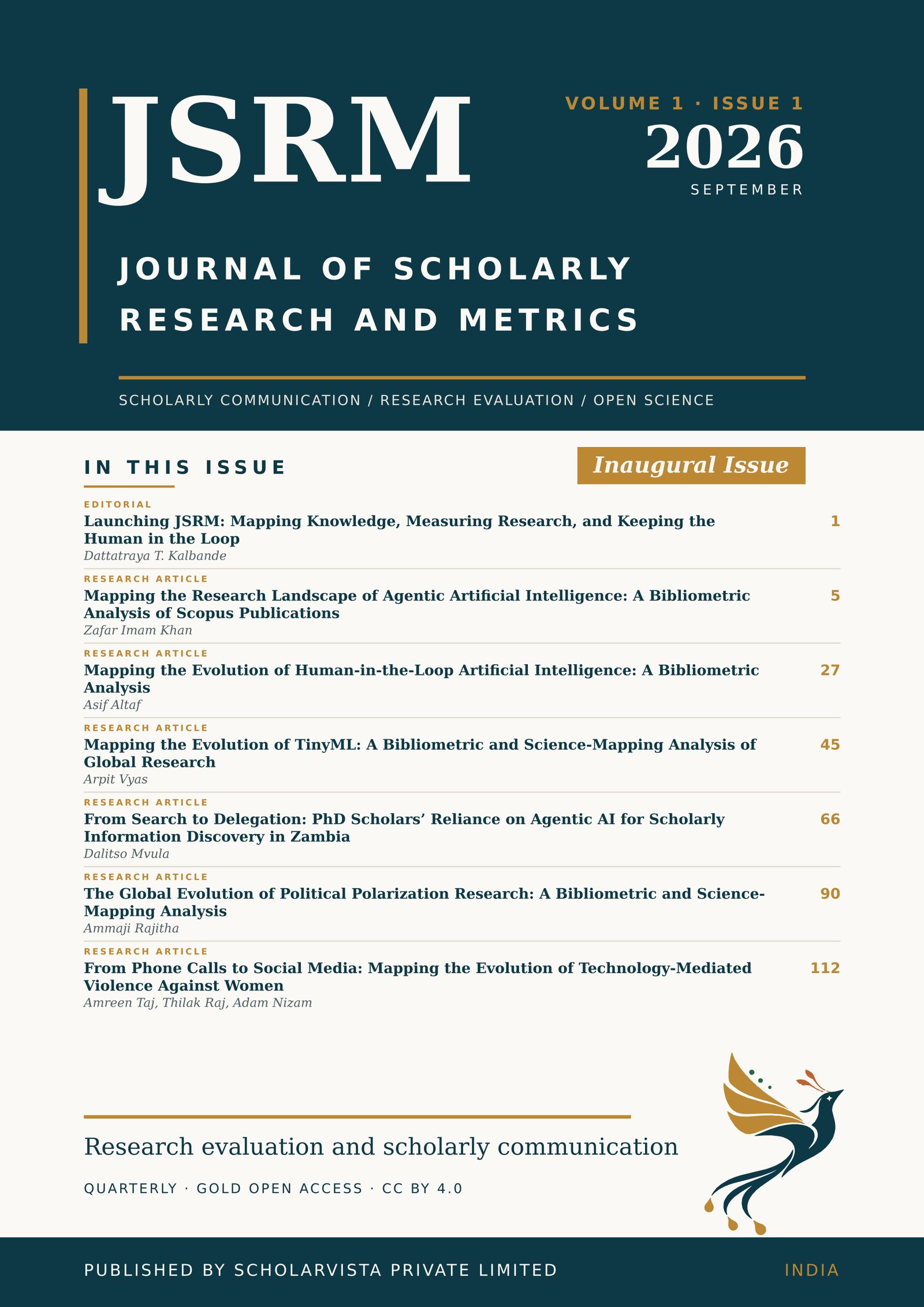
From Phone Calls to Social Media: Mapping the Evolution of Technology-Mediated Violence Against Women
Pages:
112-135Keywords:
technology-mediated violence, violence against women, social media, cyber violence, bibliometric analysis, science mappingAbstract
Context: Technology-mediated violence against women has evolved from harassment by telephone and mobile phone to abuse through the Internet, social media, and digital platforms. The field has grown rapidly but remains fragmented across terminology, disciplines, technologies, and geographical contexts.
Aim: This study traces the growth, intellectual structure, collaboration patterns, and thematic evolution of research on technology-mediated violence against women from 2001 to 2025.
Approach: A bibliometric and science-mapping analysis was conducted using Scopus data. After PRISMA-guided screening, 2,990 articles and reviews from 1,256 sources were retained. Descriptive indicators, Bradford’s law, author impact, country productivity and collaboration, and trend topics were analyzed using Bibliometrix/Biblioshiny, and co-authorship and keyword co-occurrence networks were mapped using VOSviewer.
Key Findings: The literature grew at an annual rate of 23.24% and involved 10,397 authors and 252,612 references. The United States led corresponding-author output (749 articles; 25.1%) and occupied the most central position in the international collaboration network. Research themes shifted from early psychosocial and mobile-phone concerns toward social media, online harassment, image-based sexual abuse, misogyny, and mental health.
Interpretation: Digital technologies have increasingly reshaped how, where, and through which channels violence against women is perpetrated, researched, and discussed.
Contribution: This study maps the intellectual evolution of technology-mediated violence against women and identifies key geographical, collaborative, and emerging thematic priorities for future research.
References
Backe, E. L., Lilleston, P., & McCleary-Sills, J. (2018). Networked individuals, gendered violence: A literature review of cyberviolence. Violence and Gender, 5(3), 135–146. https://doi.org/10.1089/vio.2017.0056
Bailey, J., Henry, N., & Flynn, A. (2021). Technology-facilitated violence and abuse: International perspectives and experiences. In J. Bailey, A. Flynn, & N. Henry (Eds.), The Emerald International Handbook of Technology-Facilitated Violence and Abuse (pp. 1–17). Emerald Publishing Limited. https://doi.org/10.1108/978-1-83982-848-520211001
Bansal, V., Rezwan, M., Iyer, M., Leasure, E., Roth, C., Pal, P., & Hinson, L. (2024). A scoping review of technology-facilitated gender-based violence in low- and middle-income countries across Asia. Trauma, Violence, & Abuse, 25(1), 463–475. https://doi.org/10.1177/15248380231154614
Benítez-Hidalgo, V., Pastor-Moreno, G., Ruiz-Pérez, I., & Amaya-Santos, S. (2026). Technology-facilitated sexual violence against women and its health impact: A mixed-methods systematic review. BMC Public Health, 26(1), 543. https://doi.org/10.1186/s12889-026-26260-4
Boethius, S., Åkerström, M., & Hydén, M. (2023). The double-edged sword – Abused women’s experiences of digital technology. European Journal of Social Work, 26(3), 506–518. https://doi.org/10.1080/13691457.2022.2040437
Boxall, H., Lawler, S., & Morgan, A. (2025). Unpacking variation in technology-facilitated intimate partner violence: A conceptual and empirical analysis. Journal of Family Violence. Advance online publication. https://doi.org/10.1007/s10896-025-00928-8
Cardoso, L. F., Sorenson, S. B., Webb, O., & Landers, S. (2019). Recent and emerging technologies: Implications for women’s safety. Technology in Society, 58, 101108. https://doi.org/10.1016/j.techsoc.2019.01.001
Carlson, B. (2026). We are the data, but never the researchers: Epistemic violence in the study of technology-facilitated abuse. Journal of Sociology. Advance online publication. https://doi.org/10.1177/14407833261423228
Choi, M., Kang, S., & Kim, Y. (2026). Understanding social media advocacy: Advocacy communication on the Violence Against Women Act. Health Communication, 41(2), 267–277. https://doi.org/10.1080/10410236.2025.2510002
Dey, A. (2024). “It’s a joke, not a dick. So don’t take it too hard”: Online sexual harassment in Indian universities. Feminist Media Studies, 24(8), 1830–1846. https://doi.org/10.1080/14680777.2023.2266150
Enock, F. E., Stevens, F., Sippy, T., Bright, J., Cross, M., Johansson, P., Wajcman, J., & Margetts, H. Z. (2026). Gendered inequalities in online harms: Fear, safety work, and online participation. Computers in Human Behavior, 181, 108990. https://doi.org/10.1016/j.chb.2026.108990
Gámez‐Guadix, M., Mateos‐Pérez, E., Wachs, S., Wright, M., Martínez, J., & Íncera, D. (2022). Assessing image‐based sexual abuse: Measurement, prevalence, and temporal stability of sextortion and nonconsensual sexting (“revenge porn”) among adolescents. Journal of Adolescence, 94(5), 789–799. https://doi.org/10.1002/jad.12064
Gullon-Scott, P. (2026). When technology becomes a weapon: The Leighton case and the human cost of technology-facilitated gender-based violence. Journal of Police and Criminal Psychology. Advance online publication. https://doi.org/10.1007/s11896-026-09836-z
Jannite, U. K., Abedin, S., & Rahman, M. M. (2025). Technology-facilitated sexual harassment and mental health symptoms among young-adult female student sample in Bangladesh. Archives of Women’s Mental Health, 28(2), 309–319. https://doi.org/10.1007/s00737-024-01498-2
Kamarudin, S., Tang, Q., Firmantoro, V., Yustisia, I. R., & Wahid, A. (2026). From harassment to datafication: A systematic evidence synthesis of women’s cybersecurity risks. Journal of Information, Communication and Ethics in Society. Advance online publication. https://doi.org/10.1108/JICES-12-2025-0423
Koch, L., Russo Riva, M. P., & Steinert, J. I. (2025). Technology-facilitated gender-based violence against politically active women: A systematic review of psychological and political consequences and women’s coping behaviors. Trauma, Violence, & Abuse. Advance online publication. https://doi.org/10.1177/15248380251343185
Koukopoulos, N., Janickyj, M., & Tanczer, L. M. (2026). Defining and conceptualizing technology-facilitated abuse (“tech abuse”): Findings of a global Delphi study. Journal of Interpersonal Violence, 41(1–2), 249–275. https://doi.org/10.1177/08862605241310465
Lombard, N., Butterby, K., Mielismäki, H., Vicente-García, R., & Pérez-Martínez, V. (2026). Introducing a chatbot to support victim-survivors of domestic abuse: Victim-survivor perspectives. Violence Against Women, 32(10), 3384–3403. https://doi.org/10.1177/10778012251363583
López-Barranco, P. J., López-Yepes, S., Conesa-Ferrer, M. B., Cayuela-Fuentes, P. S., Beladiez-Pérez, M. D. M., & Jiménez-Ruiz, I. (2025). Violence against women on social networks: A descriptive analysis. Healthcare, 13(20), 2574. https://doi.org/10.3390/healthcare13202574
Macmillan, R., Nierobisz, A., & Welsh, S. (2000). Experiencing the streets: Harassment and perceptions of safety among women. Journal of Research in Crime and Delinquency, 37(3), 306–322. https://doi.org/10.1177/0022427800037003003
McMillan, I. F., Brienzo, M. J., Gezinski, L. B., Kaniuka, A., Moxie, J., Willard, J., Yoder, A., Post, A., Reinken, M., Walker, C., Ortiz, C., & Mennicke, A. (2025). Technology-facilitated abuse among college students: Prevalence and consequences, and examinations by gender and sexual identity. Journal of Interpersonal Violence, 40(17–18), 4252–4272. https://doi.org/10.1177/08862605241287801
Pei, X., Chib, A., & Ling, R. (2022). Covert resistance beyond #MeToo: Mobile practices of marginalized migrant women to negotiate sexual harassment in the workplace. Information, Communication & Society, 25(11), 1559–1576. https://doi.org/10.1080/1369118X.2021.1874036
Powell, A., & Flynn, A. (2023). Technology-facilitated abuse victimization: A gendered analysis in a representative survey of adults. Feminist Criminology, 18(5), 435–458. https://doi.org/10.1177/15570851231196548
Powell, A., & Stockley, C. (2026). A continuum of tactics: Technology facilitated abuse in family violence crisis contexts. Australian Social Work. Advance online publication. https://doi.org/10.1080/0312407X.2026.2640928
Quilty, E., & Flynn, A. (2026). Technology-facilitated violence in the Indo-Pacific: A scoping review. Trauma, Violence, & Abuse, 27(3), 704–716. https://doi.org/10.1177/15248380251323217
Rakhmawati, D., Saptadi, H., Ratu, B., Suryadi, & Anilon, B. J. (2025). Digital footprint of violence: Bibliometric analysis of online gender-based violence with VOSviewer and Scopus. G-Couns: Jurnal Bimbingan dan Konseling, 10(01), 824–833. https://doi.org/10.31316/g-couns.v10i01.8737
Rigotti, C., & McGlynn, C. (2022). Towards an EU criminal law on violence against women: The ambitions and limitations of the Commission’s proposal to criminalise image-based sexual abuse. New Journal of European Criminal Law, 13(4), 452–477. https://doi.org/10.1177/20322844221140713
Rodríguez-García, A. M., Moreno-Guerrero, A. J., & García-Carmona, M. (2023). Retrospective and prospective analysis on “sexting”: Indicators of productivity, dispersion, and content (2009–2019). Archives of Sexual Behavior, 52(4), 1753–1766. https://doi.org/10.1007/s10508-023-02562-1
Salerno-Ferraro, A. C., Erentzen, C., & Schuller, R. A. (2022). Young women’s experiences with technology-facilitated sexual violence from male strangers. Journal of Interpersonal Violence, 37(19–20), NP17860–NP17885. https://doi.org/10.1177/08862605211030018
Seifi, L., Gala, B., & Taj, A. (2026). Bibliometric mapping of Arabic, Persian, Ottoman, and Sanskrit manuscripts research. IFLA Journal. Advance online publication. https://doi.org/10.1177/03400352261435845
Smith, M. D., & Morra, N. N. (1994). Obscene and threatening telephone calls to women: Data from a Canadian national survey. Gender & Society, 8(4), 584–596. https://doi.org/10.1177/089124394008004007
Storey, J. E., & Pina, A. (2025). Technology-facilitated intimate partner violence: An examination of prevalence, perpetration type and methods and the impact of COVID-19. Journal of Interpersonal Violence. Advance online publication. https://doi.org/10.1177/08862605251391169
Vogler, S., Kappel, R., & Mumford, E. (2023). Experiences of technology-facilitated abuse among sexual and gender minorities. Journal of Interpersonal Violence, 38(19–20), 11290–11313. https://doi.org/10.1177/08862605231179724
Watson, S. (2024). Online abuse of women: An interdisciplinary scoping review of the literature. Feminist Media Studies, 24(1), 51–69. https://doi.org/10.1080/14680777.2023.2181136
Yu, Y., Peng, Y., Liu, R., & Tao, W. (2026). Why sadistic women cyberbully: The mediating role of moral disengagement and the moderating role of gender. Cyberpsychology, Behavior, and Social Networking, 29(3), 159–166. https://doi.org/10.1177/21522715261423753
Zhou, Y., & Peterson, Z. D. (2025). Women’s experiences of sexual harassment in online gaming. Violence Against Women, 31(8), 2037–2052. https://doi.org/10.1177/10778012241252021
Downloads
Published
Data Availability Statement
The bibliographic data were retrieved from Scopus and are available from the corresponding author upon reasonable request, subject to Scopus licensing restrictions.
Issue
Section
License
Copyright (c) 2026 Amreen Taj, Thilak Raj, Adam Nizam (Author)

This work is licensed under a Creative Commons Attribution 4.0 International License.
Authors retain copyright in their work and grant the Journal of Scholarly Research and Metrics (JSRM) the right of first publication.
Articles published in JSRM are licensed under the Creative Commons Attribution 4.0 International License (CC BY 4.0). This license permits use, sharing, distribution, reproduction, and adaptation of the work in any medium or format, provided appropriate credit is given to the original author(s) and source, a link to the license is provided, and any changes made are indicated.